



What Does “Bismillah” Mean? A Complete Islamic Explanation

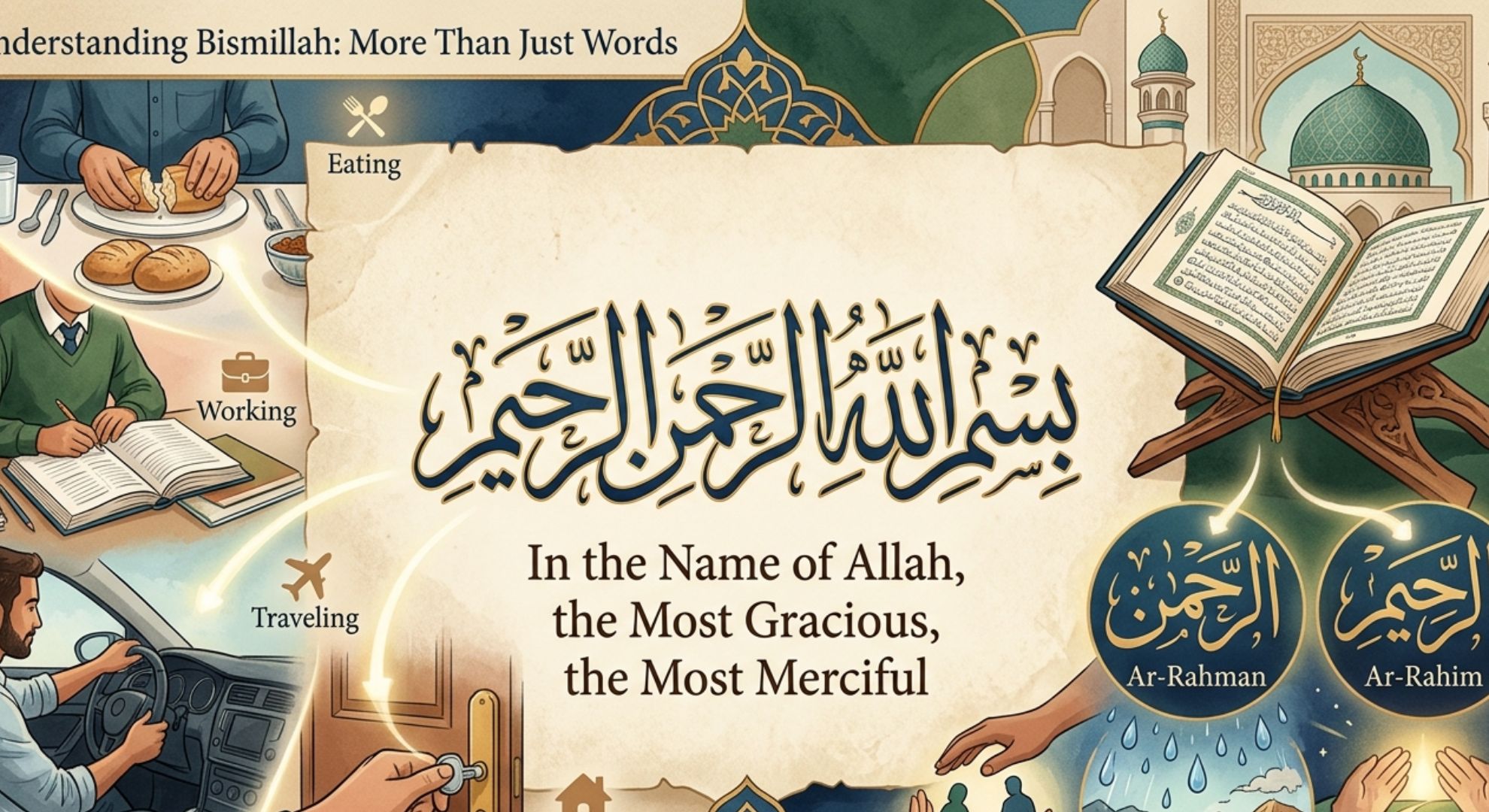
The word Bismillah is one of the most powerful and frequently recited phrases in Islam. It is commonly translated as:
“In the name of Allah.”
However, this translation captures only the surface of its meaning. The phrase carries theological, spiritual, linguistic, historical, and practical significance that shapes a Muslim’s daily life and worldview.
Understanding Bismillah is not simply about translating Arabic words into English. It is about understanding intention, divine mercy, dependence on God, and the relationship between human action and the Creator.
For Muslims, Bismillah is not just spoken — it is lived.
The Full Phrase: Bismillah ir-Rahman ir-Rahim
The complete form of the phrase is:
بِسْمِ ٱللَّٰهِ ٱلرَّحْمَٰنِ ٱلرَّحِيمِ
Bismillah ir-Rahman ir-Rahim
It means:
“In the name of Allah, the Most Gracious, the Most Merciful.”
This phrase is known as the Basmala.
It appears at the beginning of 113 out of 114 chapters (Surahs) of the Qur’an, highlighting its foundational importance in Islamic belief, worship, and spiritual consciousness.
The only chapter that does not begin with it is Surah At-Tawbah.
This repeated placement shows that divine mercy precedes guidance, law, and accountability.
Word-by-Word Breakdown of Bismillah
To understand its depth, we must examine its components individually.
1. “Bi” (بِ)
This preposition can mean:
- In
- By
- With
It indicates reliance and seeking assistance. When a Muslim says “Bi,” they are beginning an action with the help and authority of Allah.
It reflects humility — a recognition that success does not come from human power alone.
2. “Ism” (اسم)
This means:
- Name
In Arabic theology, a “name” is not just a label. It represents:
- Authority
- Essence
- Attributes
- Divine qualities
Thus, saying “In the name of Allah” means invoking His attributes — His mercy, power, wisdom, and guidance.
3. “Allah” (الله)
“Allah” is the proper and unique name of God in Islam.
It refers to:
- The One Creator
- The Absolute
- The Self-Sufficient
- The One without partners
Unlike titles such as “Lord” or “God,” the name Allah is uniquely personal and encompasses all divine attributes.
The Meaning of Ar-Rahman and Ar-Rahim
The two final names in the full phrase come from the same Arabic root: R-Ḥ-M, meaning mercy and compassion.
Ar-Rahman
The Universally Merciful
His mercy encompasses all creation — believers and non-believers alike.
Ar-Rahim
The Specifically Merciful
A special, ongoing mercy directed toward the believers.
Together, these names emphasize that every action begun with Bismillah is placed under divine mercy.
Mercy is not an afterthought in Islam — it is the foundation.
Why Do Muslims Say Bismillah Before Everything?
Muslims recite Bismillah before:
- Eating and drinking
- Studying
- Beginning prayer
- Starting work
- Writing
- Traveling
- Entering the home
The purpose is not ritual repetition. It is transformation.
Saying Bismillah:
- Aligns intention (niyyah) with worship
- Seeks blessings (barakah)
- Prevents arrogance
- Reminds the heart of divine presence
The Prophet Muhammad ﷺ encouraged saying Bismillah before eating, teaching that it prevents Shaytan from sharing in one’s food.
This simple phrase spiritually reframes daily life. It turns ordinary acts into acts of devotion.
If you are studying foundational Islamic concepts like intention (niyyah), worship, and daily supplications, structured learning through our Islamic Studies courses can help deepen your understanding of these core principles in a guided and authentic way.
Bismillah in the Qur’an
The Basmala holds a unique status in the Qur’an:
- It opens nearly every chapter.
- It appears within Surah An-Naml (27:30) in the letter of Prophet Sulayman (Solomon).
- Many scholars consider it the first verse of Surah Al-Fatiha.
Its placement teaches an important theological lesson:
Before commandments comes compassion.
Before law comes mercy.
Before accountability comes guidance.
This order is not accidental — it reflects divine wisdom.
Students who wish to explore deeper Qur’anic interpretation (Tafsir), linguistic analysis, and theological implications can benefit from structured programs in Islamic Studies, where these foundational concepts are studied systematically.
Linguistic Origin of the Word “Basmala”
The term Basmala itself is linguistically remarkable.
Arabic scholars created it by combining the first consonants of the phrase “Bismillah ir-Rahman ir-Rahim” into a new quadriliteral root: B-S-M-L.
This process shows how frequently the phrase was used in early Islamic society — it became so common that it evolved into its own technical term.
Such linguistic formation reflects both reverence and practical usage.
Historical and Cultural Context
Historically:
- Early Arabian inscriptions before Islam included similar invocations.
- Islamic civilization standardized and universalized Basmala.
- It became a standard opening for letters, documents, and scholarly works.
Even today, many Muslim-majority countries begin official documents with the Basmala.
In daily life, it appears in:
- Calligraphy
- Architecture
- Legal documents
- School textbooks
Interestingly, the word also gained recognition in Western culture through its appearance in the song “Bohemian Rhapsody.”
For those curious about how English speakers interpret and discuss the word, you can explore this detailed discussion on the meaning of Bismillah, where different linguistic explanations and contextual translations are shared from a non-Islamic perspective.
Spiritual Philosophy Behind Bismillah
Bismillah teaches three major spiritual principles.
1. Intention Before Action
Islam emphasizes that actions are judged by intention.
Beginning with Bismillah purifies the heart before the body acts.
It reminds the believer:
“Why am I doing this?”
2. Dependence on God
Human beings plan.
Allah controls outcomes.
By saying Bismillah, a Muslim acknowledges:
- My ability is limited.
- My success depends on divine will.
This prevents pride and cultivates gratitude.
3. Mercy Precedes Judgment
Nearly every chapter of the Qur’an begins with mercy.
This establishes a powerful theological framework:
Divine compassion frames divine law.
Islam is not built on fear — it is built on mercy.
The Number 786 – Is It Islamic?
In some South Asian Muslim cultures, the number 786 represents Bismillah using the Abjad numerical system.
However:
- It is not mentioned in the Qur’an.
- It is not mentioned in authentic Hadith.
- It is a cultural tradition, not a doctrinal requirement.
Understanding the distinction between cultural expression and authentic Islamic teaching is important for serious students of religion.
Bismillah and Islamic Education
Learning the meaning of Bismillah is not just about vocabulary. It opens the door to understanding:
- Tawhid (Oneness of Allah)
- Divine Names and Attributes
- Qur’anic structure
- Worship and daily supplications
- Spiritual discipline
It teaches that Islam is not confined to ritual moments. It extends into:
- Work
- Family life
- Study
- Speech
- Thought
For those who wish to move beyond surface translations and truly understand Islamic theology and practice in depth, our comprehensive Islamic Studies program offers structured, guided learning with qualified teachers.
When properly understood, Bismillah becomes the foundation of a believer’s mindset.
Final Reflection
Bismillah is more than a phrase.
It is:
- A declaration of faith
- A statement of humility
- A request for mercy
- A reminder of dependence
- A transformation of action into worship
When a Muslim says Bismillah, they are not merely speaking words.
They are placing their action under divine guidance.
They are beginning with awareness.
They are acknowledging that life is not random — it is purposeful.
And that simple shift changes everything. Read more.